FDA recommends restaurants, food manufacturers cut back on use of salt

October 15, 2021

The new guidance hopes to reduce overall sodium intake by 12%.
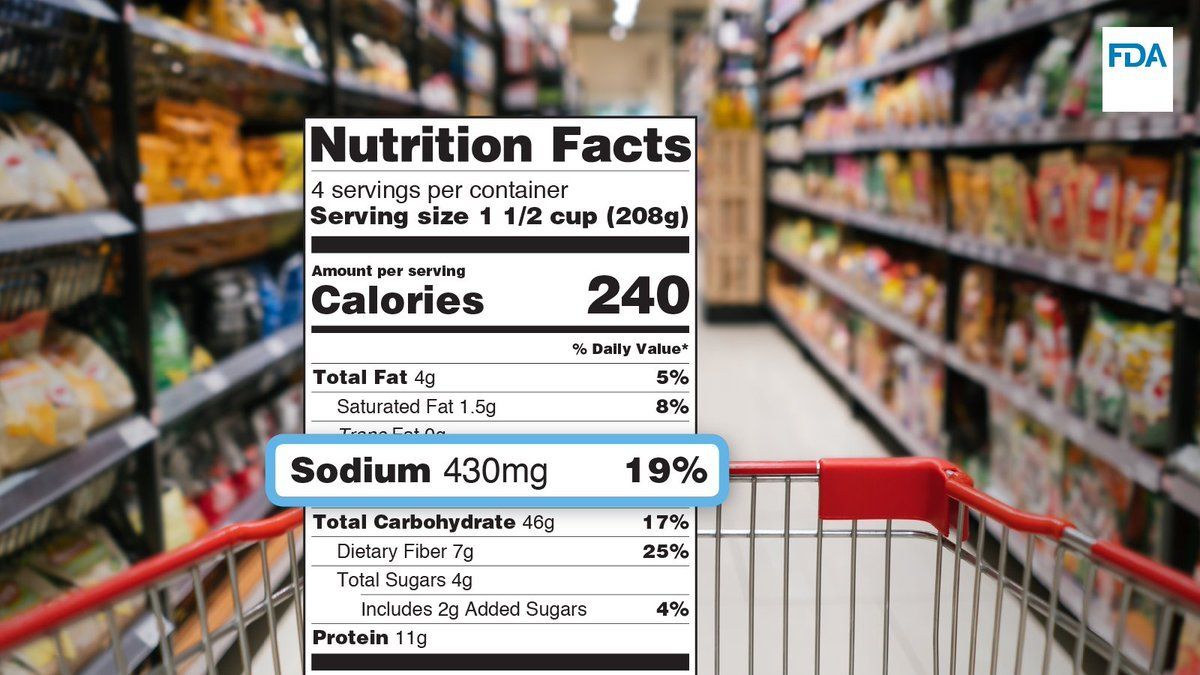
The U.S. Food and Drug Administration has released sweeping new guidance for the food industry to voluntarily reduce sodium in processed, packaged and prepared foods in an attempt to reduce Americans' consumption.

"The FDA is issuing a final guidance, 'Voluntary Sodium Reduction Goals: Target Mean and Upper Bound Concentrations for Sodium in Commercially Processed, Packaged, and Prepared Foods,' which provides voluntary short-term sodium reduction targets for food manufacturers, chain restaurants and foodservice operators for 163 categories of processed, packaged and prepared foods," the agency announced.


Acting FDA Commissioner Dr. Janet Woodcock lauded the new sodium reduction guidance in a press conference Wednesday morning. She said it is a "critical step" in improving Americans' nutrition, reducing the burden of diet-related chronic diseases and advancing health equity, predicting the effort would "become one of the most significant public health nutrition interventions in a generation."


The guidance is intended to provide measurable voluntary short-term goals over the next two and a half years to reduce excess sodium intake, while recognizing and supporting the important roles sodium plays in food technology and food safety.

ABC News chief medical correspondent Dr. Jennifer Ashton said the news from Woodcock and Susan T. Mayne, director of the FDA's Center for Food Safety and Applied Nutrition, is "really targeting the food industry."

The current salt intake recommendation of 3,000 milligrams per day is now set to a goal of 2,300 milligrams a day over the next two and a half years.


"Right now, it is clear that diet is a major contributing factor to not only our obesity, but high blood pressure, which, of course, then increases the risk for heart attack [and] strokes," Ashton said.

Woodcock voiced hope that this voluntary guidance that targets the food industry itself -- rather than leaving the onus on individuals -- will help level the playing field for Americans who may not be well-equipped to police their nutrition alone, especially with sparse healthy food options in food deserts and due to some healthier food options being cost-prohibitive for lower-income families.

"The problem is so cumulative -- it's the tomato sauce, the cheese, the bread, the salad dressing, and pretty soon your whole meal has hidden salt in it. And it's really hard right now for people to manage that on their own," Woodcock said. "Most of the salt in the diet, the sodium in the diet, it comes from processed or packaged or prepared foods -- not from the saltshaker."


"Sodium is widely present in the American diet (most commonly, but not exclusively, as a result of eating or drinking foods to which sodium chloride, commonly referred to as "salt," has been added)," according to the FDA. "More than 70% of total sodium intake is from sodium added during food manufacturing and commercial food preparation."

During the same press conference, Health and Human Services Secretary Xavier Becerra underscored Woodcock's point that neglecting to address sodium consumption would carry high human and economic costs. He added that the COVID pandemic has shown the importance of taking better care of one's health.

"The pandemic has graphically illustrated why today's announcement is so important and why it's so important that we take care of our health," Becerra said, adding the consequences of Americans' sky-high sodium intake could be "catastrophic personally and for the country."


Mayne said that this issue impacts all age groups with "more than 95% of children age two to 13 who exceed recommended sodium limits for their age groups -- even baby food -- which carries long-term ramifications for children's health and development," she said.


But being that this is voluntary, truly capping sodium intake effectively will require a groundswell of both industry cooperation and consumer demand to help drive the initiative.

When asked whether there would need to be more teeth behind such policy, Woodcock said the government would monitor the impact of this current guidance over time, pointing to the importance of public support.

"If we don't see success, then we're going to have to evaluate what else we should do," Woodcock said, without ruling out the idea of further, more stringent future measures.

"We have a plan to monitor and then to ratchet it further down, and what we learn over the next several years will tell us what magnitude of steps we can take," Woodcock said. She acknowledged that "this change won't happen overnight" and will require "an iterative approach that supports gradual reduction in sodium levels, broadly across the food supply, over time."


Source: ABC News

February 27, 2026
ABC News' Dr. Tara Narula breaks down a new study that finds women who follow a Mediterranean diet will have a significantly lower risk of having a stroke.
February 12, 2026
Christopher "Kid" Reid, half of the hip-hop duo Kid 'n Play, is revealing he underwent a heart transplant, speaking about his health condition for the first time on " Good Morning America. " The rapper, who first gained fame in the 1980s and 1990s alongside collaborator Christopher "Play" Martin, spoke with "GMA" co-anchor Michael Strahan in a segment airing Thursday, sharing he was diagnosed with congestive heart failure after an emergency room visit last July. Reid said initially, he began experiencing fatigue and shortness of breath, which he said he attributed to getting older. "I think sometimes you kinda just chalk it up to, you know, 'I'm gettin' older,' you know, 'The road is harsh,'" he said. Eventually, when his symptoms intensified last summer, Reid said he visited an emergency room, where he received his diagnosis. Reid said he was first given medication to treat the condition, but at a three-week follow-up appointment, his cardiologist grew concerned. "He came in very swollen again, and that is a little unusual in somebody who's been started on treatment, for the swelling to come back that quickly," Erika Jones, Reid's cardiologist, told "GMA." That evening, instead of flying across the country for a performance as Reid had planned, Jones urged him to stay put and ran additional bloodwork. "The blood work confirmed my suspicion. It showed that his heart was failing, and it was starting to affect his other organs," Jones said. Reid said he received a call a few hours after his appointment, urging him to go to the emergency room, where he was rushed to the ICU. Reid was told by doctors that a heart transplant would be his only option, and he was placed on a transplant waitlist. Cardiothoracic surgeon Dr. Laura Dichiacchio, one of Reid's doctors, told "GMA" that Reid was placed on the transplant waiting list because it was "a kind of life or death situation." Dichiacchio described Reid as "warm" and "incredibly calm." Reid said eight days after being placed on the transplant waitlist, he received a call with the welcome news that he would get a new heart the following evening. Reid said he arrived for the surgery, and seven hours later, he had a new heart. Reid said he plans to cherish his second chance at life, saying, "This thing is ... a beautiful life. It's great. And, you know, I wanna be around for it." He added that he hoped to inspire others, particularly people of color, to put their health first and seek medical attention when things don't feel right. "A lot of times, we don't go because we don't want the bad news, or we too busy just hustlin', trying to make it from day to day," he said. "And we ... feel like we don't got time, or we'll get over it. Well, you might not." According to the Centers for Disease Control and Prevention, in the U.S., about 6.7 million adults aged 20 or older have heart failure, a condition that happens "when the heart cannot pump enough blood and oxygen to support other organs in your body." The CDC cites hypertension, diabetes, and coronary artery disease as common risk factors for the disease. According to the National Heart, Lung, and Blood Institute, heart failure is a serious condition that requires medical care. Treatment can include heart-healthy lifestyle changes such as lower sodium intake, regular physical activity, and limited alcohol consumption, as well as medication, devices such as a pacemaker, and heart surgery or transplant.
By Alison Bowles February 3, 2026
The body content of your post goes here. To edit this text, click on it and delete this default text and start typing your own or paste your own from a different source.
August 11, 2025
ABC News' Dr. Tara Narula breaks down a new study that looks at the potential connection between kids frequently being on devices and developing heart disease.
July 16, 2025
ABC News ' Dr. Tara Narula explains how doctors at Northwell Health in New York are using mammograms to help identify women at risk for heart disease.
July 3, 2025
ABC News' Dr. Tara Narula breaks down a new study showing that while deaths from heart attacks have dropped, heart failure and arrhythmias are on the rise.
May 20, 2025
A child with a mechanical heart valve has received a living donor valve for the first time. From GoodMorning America May 12, 2025
May 12, 2025
ABC News' Dr. Tara Narula shares what to know as doctors report seeing more strokes in patients under 45.
April 30, 2025
ABC News' Dr. Tara Narula explains the essential heart tests you should be getting now.
February 21, 2025
Ed Wesolowski collapsed at a Duquesne women’s basketball game in January. Then, the Duquesne basketball medical staff jumped into action to save Wesolowski's life.